
EN

EN
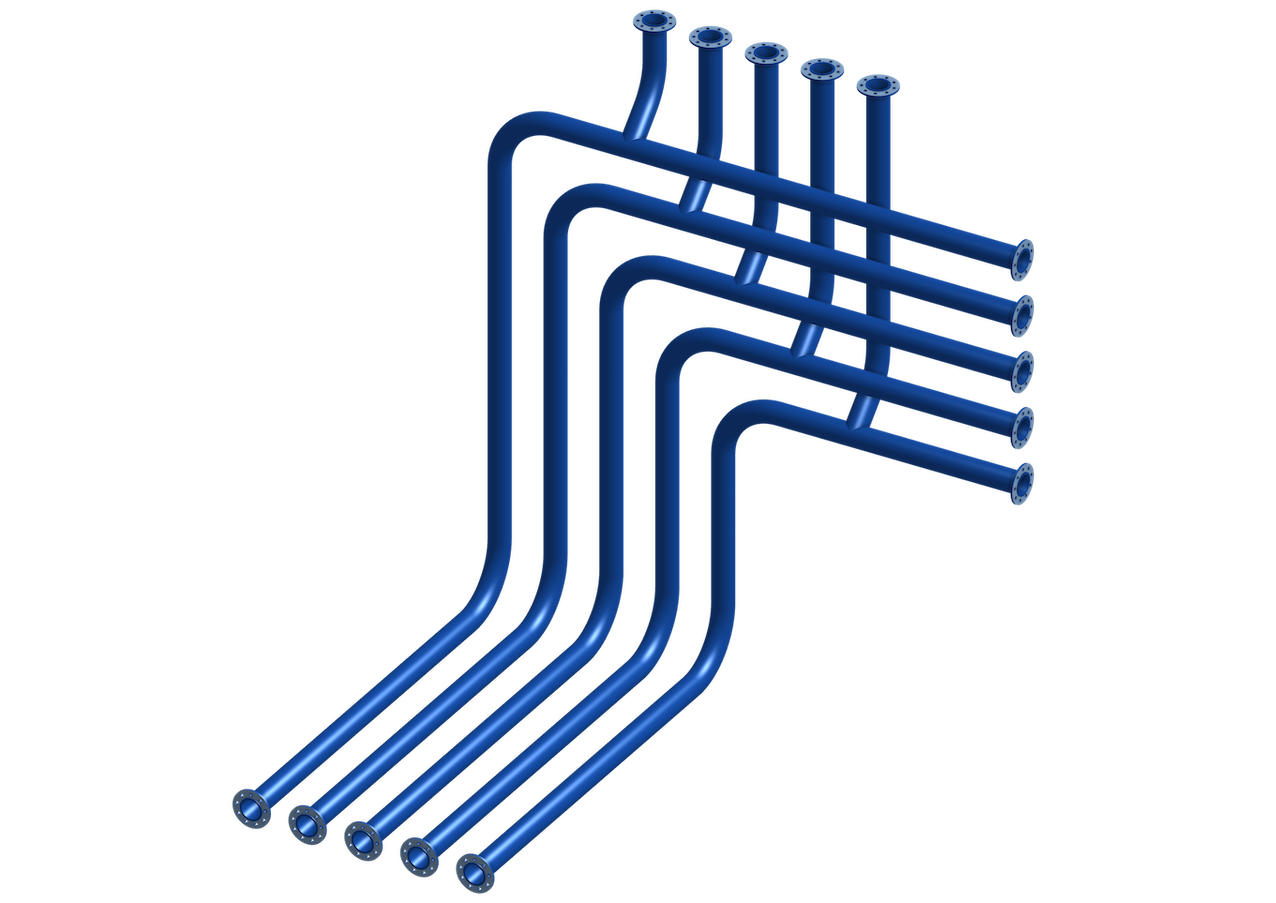
Exemplary representation. Not to scale.
Pipes connect the components of a process plant, transferring liquid or gaseous media by means of a pressure gradient which is usually created by pumps or compressors. It is ensured that no phase changes or chemical transformations of the process media occur within pipes, as these could cause harmful effects like increased erosion or steam hammer. For the sizing of pipes, the change of the operating pressure along the pipe is considered among other things as well as the flow velocity with regard to noise emissions and long term abrasion of the pipe material. Abrasion of the pipe material is particularly relevant in case of process media containing solid particles.
Although most pipes by themselves do not take up much space, the space required by all the pipes can make up a significant fraction of the size of a process plant and can accordingly impact the positioning and installation of the plant components.
The operating pressure along a pipe is influenced by dynamic pressure losses, caused by the flow of the process media, as well as by hydrostatic pressure changes. The dynamic pressure losses can be estimated using the Darcy‑Weisbach equation. The friction factor contained by the equation can either be calculated using the Colebrook-White equation, or it can be taken from the so-called Moody‑diagram. In either case, to determine the friction factor, the surface roughness of the pipe as well as the Reynolds‑number of the flow must be known.
Particularly in case of gaseous media when calculating the pressure losses it must be considered that the decrease in density usually occurring with a reduction of the operating pressure can lead to an increase of the flow velocity. Depending on the extent of the pressure losses and the associated decrease of the operating pressure it might be necessary that the calculation accounts for the change in density along the pipe in order to get reliable results.
The term water hammer refers to critical changes of the pressure which can occur in case of abrupt changes of the velocity of a process medium. Depending on the total mass of the moving medium and the change of the velocity, deceleration of a process medium can cause pressure surges. These pressure surges can reach levels that have an impact on the sizing of the pipes and the connected components, as well as the stability of the support structure. In addition to pressure surges downstream of the moving process media, pressure drops to vacuum can occur upstream.
The pipe routing has a crucial impact on the operating pressure within pipes, particularly in case of differences in elevation resulting in changes of the hydrostatic pressure. Additionally, the pipe routing influences the abrasion of the pipe material as caused by the flow of the process medium. If required, in case of pipes containing liquids appliances are implemented to prevent air pockets, as these can lead to reductions of the available operating pressure at pipe sections running in vertical direction.
If required, pipes containing vaporous media are equipped with condensate drains, either mechanical or controlled via the process control system, in order to remove condensed vapour in the form of condensate.