
EN

EN
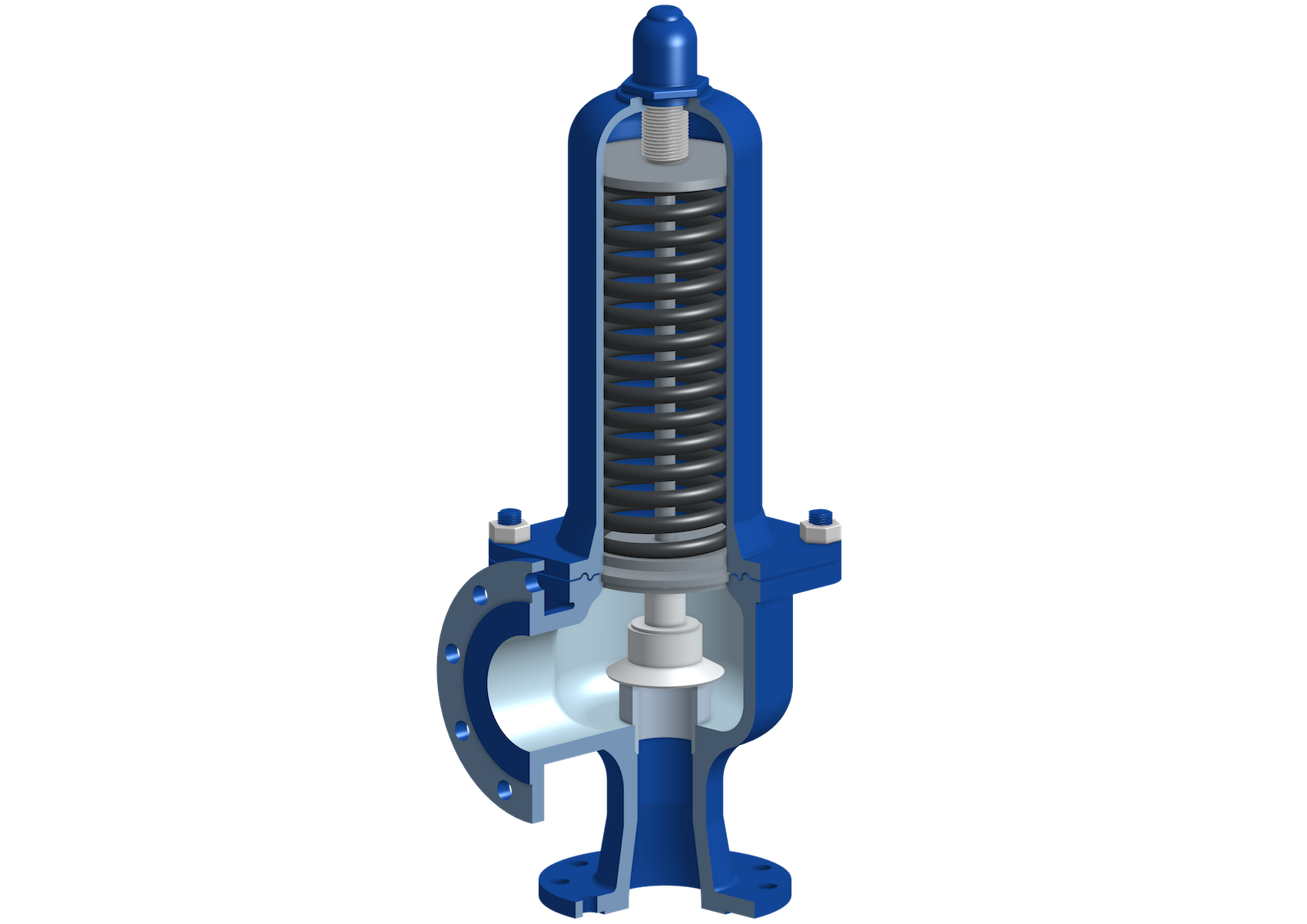
Exemplary representation. Not to scale.
Safety valves are used to protect the components of a plant against high pressure conditions which would exceed their corresponding design pressures. Safety valves open if a certain pressure is reached to release process medium from the affected plant volume in order to prevent a further increase of the pressure. They are commonly installed at the upper end of the protected volume so that the hydrostatic pressure needs to be considered when defining the design pressure for components located further below. For the fabrication of safety valves, the conformity assessment procedures according to category IV of the pressure equipment directive 2014/68/EU are applied.
Safety valves must only open in the case of upset conditions, meaning that there must be at least one independent mechanism that is meant to prevent the pressure from increasing up to the set pressure of the safety valve. The safety valve limits the pressure if this mechanism fails.
The pressure at which a safety valve opens is called the set pressure. In contrast, the pressure at which the safety valve closes again is called the reseating pressure. The reseating pressure is usually expressed as a percentage of the set pressure and often has a value of around 90%. In this case, a safety valve that has opened will not close again until the pressure within the affected system volume has dropped to a level 10% below the set pressure. For spring loaded safety valves, this difference between set pressure and reseating pressure can be achieved by the application of a so‑called huddle chamber. The huddle chamber causes the area by which the pressure of the process media generates a force that is directed against the spring to be larger when the safety valve is open compared to when it is closed. Due to this difference, the pressure required within the corresponding plant volume in order to keep an already open safety valve in the open state is smaller than the pressure required to initially open the safety valve.
The difference between set pressure and reseating pressure is called blow‑off. Like the reseating pressure it is commonly expressed as a percentage of the set pressure.
The relieving pressure refers to the pressure within the protected plant volume at which the safety valve attains the maximum discharge capacity as requested by the sizing. The relieving pressure is usually expressed as a percentage of the set pressure and can happen to exceed it. The permitted maximum difference between set pressure and relieving pressure depends on the applicable norms. According to the pressure equipment directive 2014/68/EU the set pressure may be exceeded by a value of 10%.
The difference between set pressure and relieving pressure is called overpressure. Like the reseating pressure it is commonly expressed as a percentage of the set pressure.
Spring loaded safety valves can be equipped with so‑called balanced bellows to prevent the pressure on the discharge side of the safety valve to have an impact on the opening and closing behaviour. It must be taken into account that in a pressure relief event any increase of the pressure on the discharge side caused by dynamic pressure losses in the discharge line still reduces the pressure difference across the safety valve and by that has an impact on the discharge capacity of the safety valve.
In a pressure relief event, when a safety valve is activated, dynamic pressure losses occur via the inlet and outlet lines. These pressure losses have an impact on the process conditions at the safety valve and must be considered for the sizing in order to ensure that the required discharge capacity will be reached regardless.
Excessive dynamic pressure losses via the inlet lines can reduce the pressure difference across the safety valve such that it closes prematurely when the pressure inside the plant volume is still too high. With the flow interrupted and the dynamic pressure losses gone, the pressure difference across the safety valve rises again, which can cause the safety valve to open anew. This effect can cause the safety valve to open and close in quick succession and to eventually incur damage.